文
| ||||||||
Translingual[edit]
| Stroke order | |||
|---|---|---|---|

| |||
Han character[edit]

文 (radical 67, 文+0, 4 strokes, cangjie input 卜大 (YK), four-corner 00400, composition ⿱亠乂)
- Kangxi radical #67, ⽂.
Derived characters[edit]
Descendants[edit]
- 𘱒 (Khitan Small Script)
References[edit]
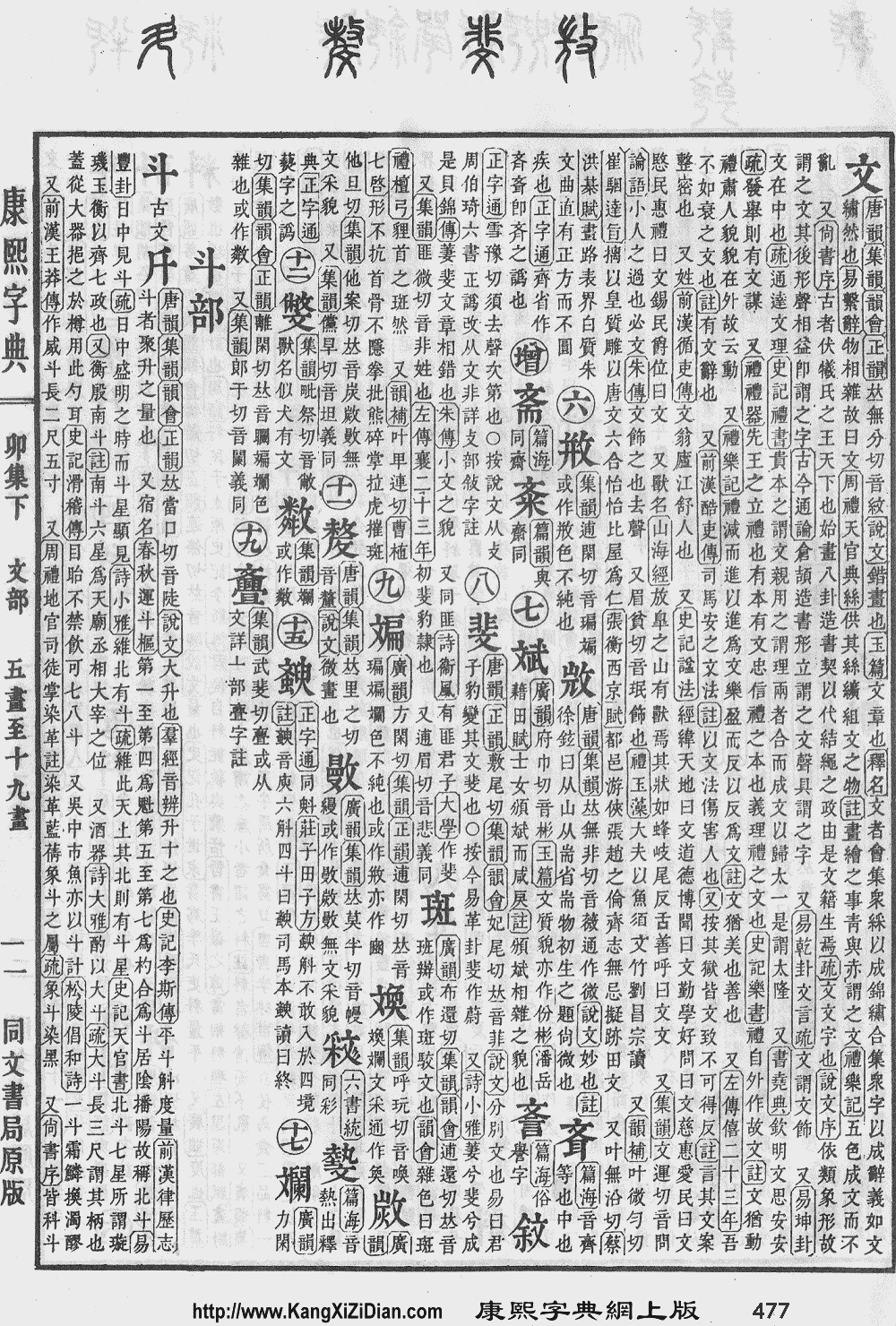
- KangXi: page 477, character 1
- Dai Kanwa Jiten: character 13450
- Dae Jaweon: page 831, character 39
- Hanyu Da Zidian (first edition): volume 3, page 2169, character 1
- Unihan data for U+6587
Chinese[edit]
| simp. and trad. |
文 | |
|---|---|---|
Glyph origin[edit]
| Historical forms of the character 文 | ||||
|---|---|---|---|---|
| Shang | Western Zhou | Warring States | Shuowen Jiezi (compiled in Han) | Liushutong (compiled in Ming) |
| Oracle bone script | Bronze inscriptions | Chu Slip and silk script | Small seal script | Transcribed ancient scripts |

|

|

|

|

|
Ideogram (指事): a man with a painted or tattooed chest – original form of 紋. In current form, tattoo has vanished, so simply an outline of a man (head, outstretched arms, legs, chest). Compare 大, which has no chest.
Pronunciation 1[edit]
Definitions[edit]
文
- † Original form of 紋/纹 (wén, “mark, pattern, design, tattoo, decoration”).
- 文如貍 / 文如狸 [Classical Chinese] ― wén rú lí [Pinyin] ― having a pattern like that of a wild cat
- Original form of 紋/纹 (wén, “to tattoo”).
- writing; literary composition; literature (Classifier: 篇 c)
- literary
- Short for 文讀/文读 (wéndú, “literary reading”).
- script; written form
- (written) language
- culture
- of a government position, non-military: civil, civilian
- refined; educated; cultured; intellectual
- 47th tetragram of the Taixuanjing; "pattern, repetition" (𝌴)
- (archaic) Classifier for coins.
- (numismatics) mill (a tenth of a cent)
- A surname.
Compounds[edit]
|
|
|
Pronunciation 2[edit]
Definitions[edit]
文
Pronunciation 3[edit]
| For pronunciation and definitions of 文 – see 蚊 (“(Cantonese) yuan; dollar; buck”). (This character, 文, is a variant form of 蚊.) |
Japanese[edit]
Kanji[edit]
Readings[edit]
- Go-on: もん (mon, Jōyō)
- Kan-on: ぶん (bun, Jōyō)
- Kun: ふみ (fumi, 文, Jōyō); あや (aya, 文)
- Nanori: かざり (kazari); ふ (fu); も (mo)
Etymology 1[edit]
| Kanji in this term |
|---|
| 文 |
| もん Grade: 1 |
| on’yomi |
From Middle Chinese 文 (mjun, “ornate; a kind of coin; language, literature, a letter, a character”).
Pronunciation[edit]
Noun[edit]
- the mon, an old currency
- a unit of length for measuring the size of one's foot (from the way that the mon coins would be lined up and used as a kind of inch marker)
- a character, a letter
- writing, something written
- a magical spell
- (also spelled 紋) a design, a pattern
- (also spelled 紋) a 家紋 (kamon, “family crest”)
Usage notes[edit]
The design and crest senses are more often spelled 紋.
Derived terms[edit]
Etymology 2[edit]
| Kanji in this term |
|---|
| 文 |
| ぶん Grade: 1 |
| on’yomi |
A later borrowing from Middle Chinese. Compare modern Min Nan reading bûn, Hakka vûn.
Pronunciation[edit]
Noun[edit]
- (grammar) a sentence
- writing, composition
- a design or pattern as decoration
- literature, learning, scholarship
- elegance, refinement (especially of writing or wording)
- a saying, an aphorism, a proverb
Derived terms[edit]
- 文案 (bun'an): a copy (advertising), copywriter (advertising); secretary; official document
- 文意 (bun'i): (grammar) semantics
- 文化 (bunka): culture; cultural
- 文官 (bunkan): a civil servant, a public official
- 文学 (bungaku): literature
- 文芸 (bungei): art and culture
- 文言 (bungen): the phrasing or wording of a piece of writing; in Chinese contexts, the written style or register as opposed to the spoken style or register
- 文豪 (bungō): leading writer, author
- 文才 (bunsai): writing talent
- 文書 (bunsho): document; written record; letter; epistle
- 文章 (bunshō): (grammatical) sentence; writing; essay; composition; writing style; Fumiaki (a male given name)
- 文人 (bunjin): intellectual; Fumihito (a male given name)
- 文責 (bunseki): author's responsibility (for the contents of a document)
- 文体 (buntai): writing style
- 文筆 (bunpitsu): writing, literary work, literature
- 文法 (bunpō): grammar
- 文末 (bunmatsu): end of a document
- 文脈 (bunmyaku): genre
- 文民 (bunmin): civilian
- 文明 (bunmei): civilization
- 文面 (bunmen): content of a document
- 論文 (ronbun): thesis
- 博士論文 (hakushi ronbun): a Ph.D. thesis
- 礼文島 (rebuntō): Rebun Island
Etymology 3[edit]
| Kanji in this term |
|---|
| 文 |
| ふみ Grade: 1 |
| kun’yomi |
Possibly a shift from an older Middle Chinese-derived reading pun.[3] Earlier Japanese writing was ambiguous regarding the final n sound spelled ん in modern Japanese, with this sound often spelled (and possibly pronounced) as む (mu) instead.
*/pumu/ → /pumi/ → /ɸumi/
This reading appears in the Heian period, in works such as The Tale of Genji.[3][1]
Pronunciation[edit]
Noun[edit]
- writing, something written
- a letter (written communication), an epistle
- (archaic) study, scholarship (especially of classical Chinese)
- a style of 家紋 (kamon, “family crest”)
Synonyms[edit]
- (letter, epistle): 手紙 (tegami)
Derived terms[edit]
- 恋文 (koibumi): a love letter
Etymology 4[edit]
| Kanji in this term |
|---|
| 文 |
| あや Grade: 1 |
| kun’yomi |
Uncertain. Appears in texts from the early Heian period.[3][1]
Pronunciation[edit]
Noun[edit]
- (also spelled 紋, 綾)
- a pattern, a design, especially one with diagonally crossing lines
- a diagonal crossing
- a flowery expression or turn of phrase
- a plot, a scheme
- a refrain or recurring phrase in a piece of music
- a harder vein or grain in a leaf or piece of wood or bamboo
- a stain, a blemish
- a mediator, a go-between (apparently from the way that a go-between can make the relationship more indirect and indistinct)
- a small indistinct fluctuation in a trend line
- (also spelled 綾, 絢)
Usage notes[edit]
For the second group of senses, the 綾 spelling is more common.
Derived terms[edit]
- 奇 (aya), 怪 (aya): mystifying, mysterious, strange (from the way that an aya pattern could confound the eyes)
- 綾織 (ayaori): a twill weave; someone who weaves twill
- 綾竹 (ayadake): in a loom, a bamboo pole placed between the heddle and the back-beam or platen, used to improve the handling
- 綾取り (ayatori): cat's cradle
References[edit]
- ↑ 1.0 1.1 1.2 1.3 1.4 1.5 2006, 大辞林 (Daijirin), Third Edition (in Japanese), Tōkyō: Sanseidō, →ISBN
- ↑ 2.0 2.1 2.2 2.3 1997, 新明解国語辞典 (Shin Meikai Kokugo Jiten), Fifth Edition (in Japanese), Tōkyō: Sanseidō, →ISBN
- ↑ 3.0 3.1 3.2 1988, 国語大辞典(新装版) (Kokugo Dai Jiten, Revised Edition) (in Japanese), Tōkyō: Shogakukan
Korean[edit]
Hanja[edit]
- This term needs a translation to English. Please help out and add a translation, then remove the text
{{rfdef}}.
Compounds[edit]
Vietnamese[edit]
Han character[edit]
文: Hán Việt readings: văn[1][2][3]
文: Nôm readings: văn[1][2][4], von[3][5][4], vằn[1][2]
- Hán tự form of văn (“literature; letters; culture; civilization”).
Compounds[edit]
References[edit]
- CJK Unified Ideographs block
- Han script characters
- Han character radicals
- Translingual lemmas
- Translingual symbols
- Han ideograms
- Mandarin terms with audio links
- Middle Chinese lemmas
- Old Chinese lemmas
- Chinese lemmas
- Mandarin lemmas
- Dungan lemmas
- Cantonese lemmas
- Taishanese lemmas
- Gan lemmas
- Hakka lemmas
- Jin lemmas
- Min Bei lemmas
- Min Dong lemmas
- Min Nan lemmas
- Teochew lemmas
- Wu lemmas
- Xiang lemmas
- Chinese nouns
- Mandarin nouns
- Dungan nouns
- Cantonese nouns
- Taishanese nouns
- Gan nouns
- Hakka nouns
- Jin nouns
- Min Bei nouns
- Min Dong nouns
- Min Nan nouns
- Teochew nouns
- Wu nouns
- Xiang nouns
- Chinese verbs
- Mandarin verbs
- Dungan verbs
- Cantonese verbs
- Taishanese verbs
- Gan verbs
- Hakka verbs
- Jin verbs
- Min Bei verbs
- Min Dong verbs
- Min Nan verbs
- Teochew verbs
- Wu verbs
- Xiang verbs
- Chinese adjectives
- Mandarin adjectives
- Dungan adjectives
- Cantonese adjectives
- Taishanese adjectives
- Gan adjectives
- Hakka adjectives
- Jin adjectives
- Min Bei adjectives
- Min Dong adjectives
- Min Nan adjectives
- Teochew adjectives
- Wu adjectives
- Xiang adjectives
- Chinese classifiers
- Mandarin classifiers
- Dungan classifiers
- Cantonese classifiers
- Taishanese classifiers
- Gan classifiers
- Hakka classifiers
- Jin classifiers
- Min Bei classifiers
- Min Dong classifiers
- Min Nan classifiers
- Teochew classifiers
- Wu classifiers
- Xiang classifiers
- Chinese proper nouns
- Mandarin proper nouns
- Dungan proper nouns
- Cantonese proper nouns
- Taishanese proper nouns
- Gan proper nouns
- Hakka proper nouns
- Jin proper nouns
- Min Bei proper nouns
- Min Dong proper nouns
- Min Nan proper nouns
- Teochew proper nouns
- Wu proper nouns
- Xiang proper nouns
- Chinese terms with IPA pronunciation
- Chinese hanzi
- Chinese Han characters
- Chinese terms with usage examples
- Chinese nouns classified by 篇
- Chinese short forms
- Chinese terms with archaic senses
- zh:Currency
- Chinese surnames
- Mandarin terms with multiple pronunciations
- Cantonese Chinese
- Chinese variant forms
- Japanese Han characters
- Grade 1 kanji
- Japanese kanji with kun reading ふみ
- Japanese kanji with kun reading あや
- Japanese kanji with kan'on reading ぶん
- Japanese kanji with goon reading もん
- Japanese kanji with nanori reading かざり
- Japanese kanji with nanori reading ふ
- Japanese kanji with nanori reading も
- Japanese terms spelled with 文 read as もん
- Japanese terms read with on'yomi
- Japanese terms derived from Middle Chinese
- Japanese terms with IPA pronunciation
- Japanese lemmas
- Japanese nouns
- Japanese terms spelled with first grade kanji
- Japanese terms written with one Han script character
- Japanese terms spelled with 文
- Japanese terms spelled with 文 read as ぶん
- ja:Grammar
- Japanese terms spelled with 文 read as ふみ
- Japanese terms read with kun'yomi
- Japanese terms with archaic senses
- Japanese terms spelled with 文 read as あや
- Korean lemmas
- Korean Han characters
- Vietnamese Han tu
- Vietnamese lemmas
- Vietnamese Han characters
- Vietnamese Nom
- CJKV radicals